Designing digital experiences. Building intelligent solutions.
We turn vision into digital experiences and intelligent solutions — for entrepreneurs who see their digital presence as an investment.
Room for a new projectWe don't sell websites. We don't sell AI. We design digital experiences people understand, trust and remember.
Read why Devdreams exists →Customers meet your website before your team.
When your digital product and your company tell the same story, trust builds — before the first conversation. When they don't, the customer goes with the story they can see.
.png&w=3840&q=75&dpl=dpl_CfHfUXs82Xq8a2fpnARJMq6g3ajf)
Five ways we build.
It's the first meeting between a company and its customers. And an AI solution isn't automation — it's giving entrepreneurs their time back, for what they do best.
I work with entrepreneurs who take their business seriously — who know why they do what they do and want that to come across online too. If you're after something quick and cheap that just sits there, I'm the wrong choice. Who this is and isn't for.
A first impression that fits who you are.
A website isn't the end product — it's the first meeting between your business and your customer.
An indication, not a price list. After one conversation you know exactly what your project comes to — and why. You pay in instalments, spread across the project.
- Brand translation
- Colour, typography and tone that make your business recognisable — not a template everyone has.
- Build
- Fast, findable and manageable. No plugin baggage that gets in the way a year from now.
- Handover
- You update text and images yourself. We stay reachable, you're not dependent.
We map your brand, your customer and your goals before anything is drawn.
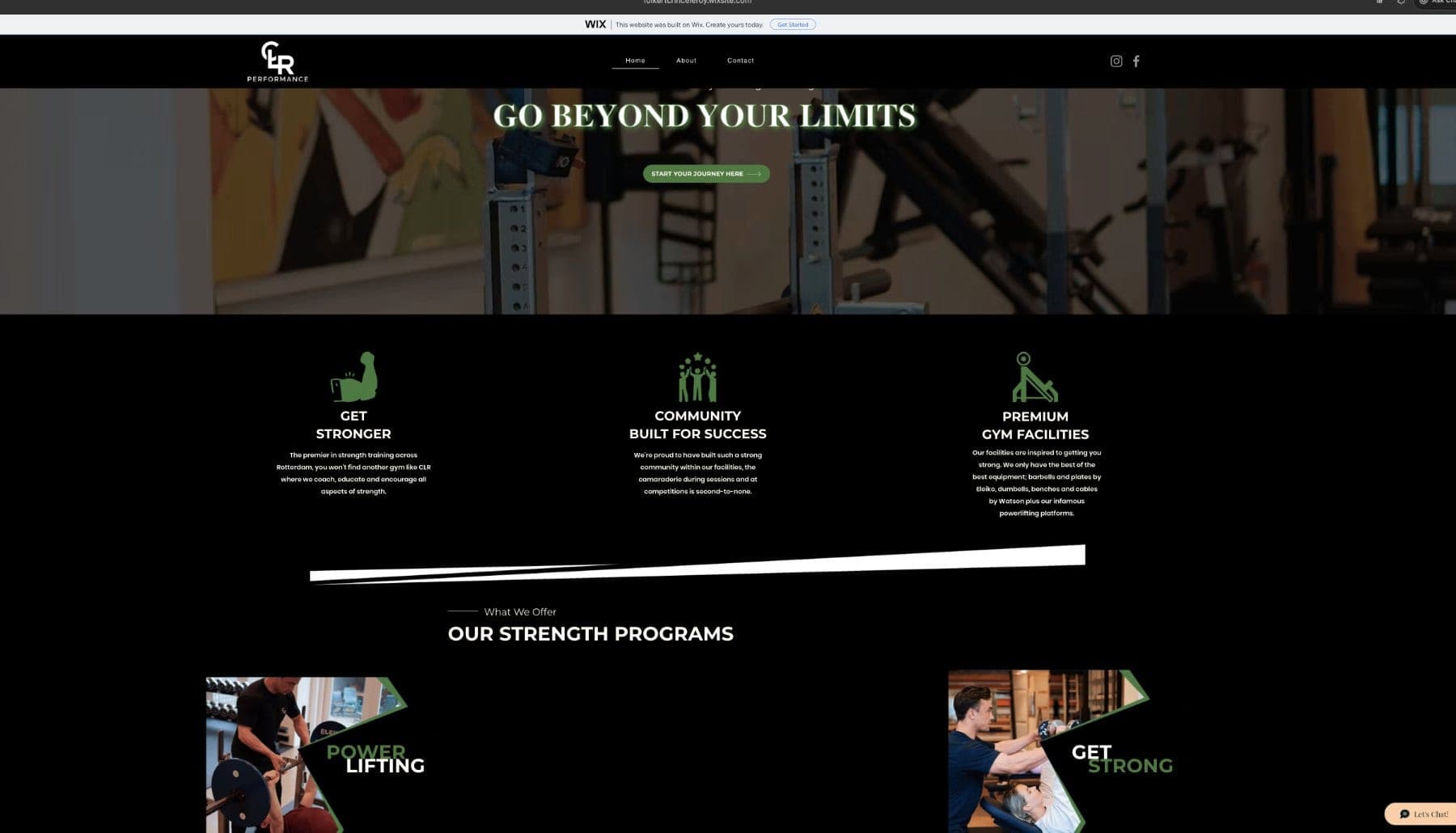
CLR Performance — where strength meets art.
A private studio with art on the walls and hundreds of hours of work a week — and a site that showed none of it. From black-on-black to the cream tones and daylight of the room itself.
.png&w=3840&q=75&dpl=dpl_CfHfUXs82Xq8a2fpnARJMq6g3ajf) Case 01 · private studio · RotterdamPhotos of the real space, prices out in the open on the page and his own story alongside — plus a second location now in the works.Next.jsPayload CMSIn-house photographyBrand translationCRM integrationRead the full case
Case 01 · private studio · RotterdamPhotos of the real space, prices out in the open on the page and his own story alongside — plus a second location now in the works.Next.jsPayload CMSIn-house photographyBrand translationCRM integrationRead the full case“For the first time my site feels like the studio itself. People walk in and say: this matches what I saw online.”
AI that takes work off your hands — not piles more on.
Four places where an assistant takes over work right away — plus a real one to try yourself. Tap the i for more on each block.
Choose what matters to you.
Tick what counts for you. Every choice sets a piece of our cloud in place — and shows how we go about it.
For each point, mark how important it is to you.
- moderate
- neutral
- important
- Very important
- Moderate
- Neutral
- Important
- Very important
- Moderate
- Neutral
- Important
- Very important
- Moderate
- Neutral
- Important
- Very important
- Moderate
- Neutral
- Important
- Very important
0 of 5 chosen
0 of 5 questions answered
What people want to know before they start.
The questions that come up in every first conversation — answered honestly, up front.
Eerlijk antwoord: best wel wat. De beste producten ontstaan als je nauw betrokken bent bij het proces, dus het komt voor dat ik meerdere keren per dag even om je feedback vraag. Reken op zo'n 30 tot 45 minuten per dag, verspreid over de dag. Dat is een bewuste keuze. Ik werk alleen met mensen die geen genoegen nemen met goed, maar precies willen wat ze voor ogen hebben. Wil je gewoon even een website? Dan ben ik waarschijnlijk niet de juiste match — en dat is prima. Er zijn genoeg partijen die snel en betaalbaar een site voor je neerzetten. Ik doe iets anders. Ik bouw niet met kant-en-klare blokken, maar ontwerp elk detail bewust — van de eerste wireframe tot de laatste animatie.
A website starts at € 4.500 and goes up with the number of pages, how much is custom, and whether a CMS or an integration is part of it. I never name a price without knowing your starting point: after one conversation you know where your project lands and why every line is in there.
No. You pay in parts, spread across the project: one part at the start, one halfway when you approve the design, and the last part at launch. That way you never pay for something that isn't there yet, and the amount tracks what has already been built. On larger projects we spread it over more instalments — we agree that beforehand, not afterwards.
Count on four to six weeks for a website, from first concept to launch. The biggest variable isn't my work but your material — copy, images and feedback rounds set the pace. We agree those moments up front, so nobody is left waiting on the other.
Yes. You get a CMS to manage pages, copy and images without needing me, plus a short walkthrough of how it works. What you can't break is the design — the structure is fixed, you fill it in.
Because a template belongs to everyone and your business belongs to you. An AI builder gets something working fast, but it makes no choices about who you are, what belongs first, and why anyone should trust you. That is exactly the work you hire someone for.
One question tells you: can you explain in a single sentence what your business stands for, and does that match what people see online? If not, we're building a fine site on shaky ground. Often the rebranding is the smaller part of the work — a few weeks — and it pays for itself, because everything after it falls into place.
No, unless that's the intention. Usually it's a matter of sharpening: what works stays, what came about by accident goes. I always show side by side what stays and what changes, with the reason for each — so you make the call, not me.
Because a template gets you a shop that looks like a thousand others. A webshop from € 7.500 isn't a pricier version of the same thing — it's photography, language and a product page that explain why your product in particular is worth it. That is exactly the work that gets skipped in a rush, and exactly the work that sells.
Yes. Often you don't have to start over: we keep your products, stock and integrations and put a layer of your own on top. Sometimes that's a new theme, sometimes a custom storefront because Shopify's standard structure is holding you back. Which it becomes, we decide after walking through your store together once.
As soon as work has to happen in your site instead of just information: requests that have a status, documents going back and forth, users with roles. If you notice your process is held together by Excel and email, that's the moment.
That always happens, which is why I build a clickable prototype first. In there, a change of course costs an afternoon instead of three weeks. After delivery we carry on in small rounds: one improvement a month instead of one big overhaul.
Yes. Your data doesn't go into a public model, you decide what the assistant may see, and every answer points to the source in your own documents. Retention periods and access are set down before anything is built.
A hundred percent. I use it when mapping out your brand, among other things: it's a strong sounding board that forces me to put things more sharply. It gets what you want onto paper in a structured way and lets me make plans that hold up before anything is built. What AI doesn't do is make the choices — that stays my work.
An assistant is not allowed to make anything up. It works only within your documents, names the source with every answer, and when it doesn't know it says so and hands over to a person. You set that boundary, not the model.
It is: entrepreneurs who stand fully behind their work, who put real time, energy and effort into it and want that to show online. People who think along, give feedback and take their trade seriously. It isn't: anyone who wants "something" online as fast and as cheap as possible, who settles for a template or an AI builder, or who won't make time for the conversation behind it. I take on a few projects a year and choose them deliberately — that is exactly why the work turns out well.
I work entirely alone — from strategy and design to build and delivery. That means one point of contact, no handover in which things get lost, and someone who holds your project in his head from start to finish. It also means I'm selective about what I take on: a few projects done well beats ten done halfway.
An hour of your time and honesty about what isn't working now. After that: your logo and images if you have them, and someone who can give feedback within a few days. We write the copy together if you don't get round to it.
You're tied to no subscription and the site is yours — hosting, code and content. If you want maintenance, we agree a fixed number of hours a month for updates and small improvements. If you'd rather do it yourself: that's fine too, you know where to find me.
Yes, those fall under Web Applications. Whether it becomes a product for many customers or a tool for your own team, it's the same problem: users, roles and a process that grows with you. The difference is mostly in how you bring it to market, and that's where the conversation starts.
Ready to make your vision visible?
No ten-field form — finish the sentence. I reply within one working day.
This is the part where you get in touch and we build something that lasts.